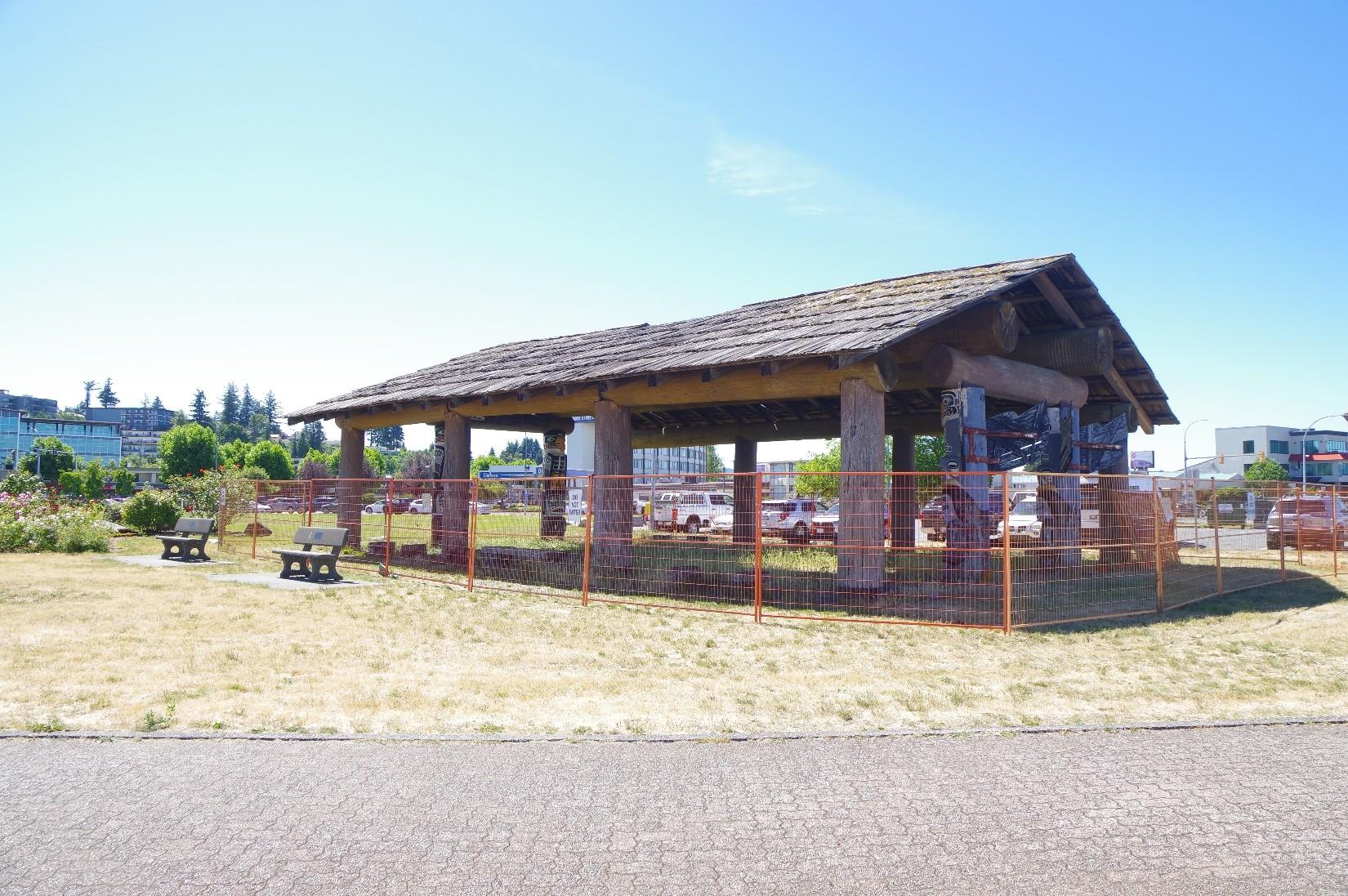
The City of Campbell River and members of the Liǧʷiɫdax̌ʷ Nation announce upcoming work on the Foreshore Pavilion located in Robert Ostler Park. Initial work will address deterioration and safety concerns while respecting the Pavilion’s cultural significance. Visitors are asked to continue taking care around the site.
Originally commissioned in 1972 and dedicated in 1973, the Pavilion has stood as a symbol of reconciliation, community pride, and cultural partnership. Known by many names—including Longhouse, Big House Pavilion, Heritage Pavilion, Foreshore Pavilion, and Awak̕wis in Kwak̕wala—it has served as a cherished gathering place for generations.
Due to structural concerns, particularly during wind and snow events, the Pavilion was closed to the public in 2023. Now 54 years old, work will be undertaken to address concerns.
A blessing ceremony attended by representatives from the Wei Wai Kum First Nation and the City of Campbell River took place on June 18, 2026. This meaningful gathering marked the start of the work, honoured the cultural significance of the site, and acknowledged the shared commitment to preserving the Pavilion as an important community and cultural landmark.
“The Pavilion’s presence on our land has been a constant reminder of our traditions and the spirit of working together,” says Chief Chris Roberts, Wei Wai Kum First Nation. “It has stood as a living legacy of reconciliation and respect between our Nation and the broader community.”
The City and Wei Wai Kum First Nation are exploring opportunities for the restoration of the Pavilion through the establishment of a joint working group with representatives from both organizations.
“The Foreshore Pavilion has been a place where stories, songs, and dances are shared and celebrated,” says Mayor Kermit Dahl. “It reflects Campbell River’s spirit of collaboration, resilience, and respect. Together with the Liǧʷiɫdax̌ʷ Nations, we are working together to shape the next chapter for the Foreshore Pavilion and are committed to honouring its cultural significance, allowing its legacy to continue for generations.”
History of the Foreshore Pavilion
The Pavilion was commissioned through the vision of the Campbell River Salmon Festival Committee in 1972. The project was supported by a Federal Local Initiatives Program Grant, which funded labour, alongside generous material donations from local companies including Elk River Timber, Raven Lumber, Crown Zellerbach, and Canadian Forest Products.
Designed by architect Sam Sauerwein in the Kwakwaka’wakw tradition, the Pavilion features carved poles and beams created by Indigenous artists including Sam Henderson and his sons, Bob Neel, Dora (Sewid) Cook, Ben Dick, Alfred Jones, Adam and Blackie Dick, and Eugene Alfred.The Pavilion was formally dedicated during the 1973 Salmon Festival with a traditional Potlatch ceremony, with dignitaries and representatives from over 12 First Nations. From that day, the City has cared for the Pavilion, while the Henderson family continued to safeguard its cultural legacy.
In 2006, restoration and repainting of the Pavilion’s carvings were led by Mark Henderson, Jr. Henderson, Patrick Hunt, and Bert Smith. The rededication ceremony echoed the spirit and traditions of the original opening, reinforcing the Pavilion’s role as a living cultural landmark.
Today, the City of Campbell River and the Liǧʷiɫdax̌ʷ Nation continue to work together to shape the Pavilion’s next chapter.
As work begins, all parties remain committed to honouring its legacy while exploring future opportunities to recognize and celebrate its cultural importance for generations to come.
###
Contact:
Rose Klukas, Director of Economic Development and Indigenous Relations, City of Campbell River | Rose.Klukas@CampbellRiver.ca | 250-286-5738
Cindy Babyn, Communications Coordinator, Wei Wai Kum First Nation | communications@weiwaikum.ca
Photo: The Foreshore Pavilion following a blessing ceremony